
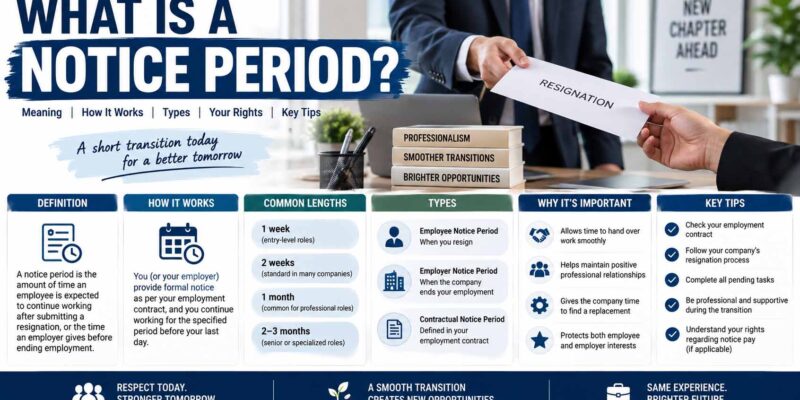
Leaving a job usually involves more than telling your manager that you will not be coming back. In most workplaces, employees give advance warning before their final working day. So, what is a notice period? A notice period is the amount of time between formally announcing that employment will end and the employee’s final day of work. Depending on the situation, either an employee or an employer may give notice, while the required length can depend on an employment contract, company policy, local law, and the circumstances of the departure.
Understanding notice periods helps employees leave professionally. At the same time, employers benefit because they gain time to transfer responsibilities, arrange staffing, and reduce disruption.
What Is a Notice Period for a Job?
A notice period is a defined period between notice of termination or resignation and the end of employment.
For example, imagine an employee submits a resignation on June 1 and has a two-week notice requirement. The employee would normally continue working during that period before reaching the agreed final working day.
However, notice periods are not identical everywhere.
Some companies specify a particular period in employment contracts. Meanwhile, legal requirements may apply depending on the employee’s location, employment status, length of service, and whether the employee or employer ends the relationship.
Therefore, workers should review their employment agreement and applicable local rules rather than assuming that two weeks always applies.
A notice period also differs from what is job abandonment, which generally involves an employee stopping work without properly communicating an intention to resign according to workplace expectations or policy.
Why Do Employers Use Notice Periods?
Notice periods create time for an orderly transition.
When an employee leaves suddenly, unfinished work can create problems for colleagues, customers, and managers. However, advance notice gives the company an opportunity to prepare.
For example, the employer may use the period to:
- Reassign projects
- Document important processes
- Inform customers or suppliers
- Begin recruiting a replacement
- Transfer passwords or authorized business access appropriately
- Train another employee
- Complete outstanding work
- Arrange final payroll and benefits administration
Notice periods can benefit employees too.
A professional departure may help preserve workplace relationships and references. Likewise, employees have time to complete projects, organize handover notes, and prepare for their next role.
Still, what happens during the notice period depends on the organization and circumstances.
What Is a Notice Period on a Job Application?
Job applications sometimes ask applicants to state their notice period. Naturally, this can confuse people who have never changed jobs while employed.
So, what is a notice period on a job application?
In this context, the employer usually wants to know how soon you could realistically start working if you receive and accept an offer.
For example, suppose your existing employment agreement requires four weeks’ notice. You would generally enter four weeks as your notice period.
Meanwhile, if you are not currently employed and can start immediately, you might state “immediately” or “available immediately,” depending on the application format.
Employers ask this question because availability affects hiring plans. For instance, a company filling an urgent vacancy may prefer someone who can start quickly. However, another employer may be perfectly comfortable waiting several weeks for the right candidate.
Therefore, answer accurately instead of promising an earlier start that you may not be able to provide.
What Is Notice Period on a Job Application if You Are Still Employed?
If you currently have a job, check your employment contract before answering.
Do not rely only on what coworkers have told you because different roles or seniority levels may have different requirements.
For example, junior employees might have a shorter notice period, while managers or senior specialists may have longer contractual periods because their responsibilities take more time to transfer.
Once you know the requirement, enter it clearly.
If the application asks what is notice period on a job application, suitable answers might include:
“Two weeks.”
“30 days.”
“Four weeks after accepting an offer.”
“Available immediately.”
Keep the answer straightforward unless the employer asks for more detail.
Also, avoid resigning from your existing job merely because you submitted an application. Usually, employees wait until they have received and accepted an appropriate offer and completed any necessary hiring steps before making a resignation decision.
How Long Is a Typical Notice Period?
There is no universal notice period that applies to every worker.
Two weeks is a familiar convention in some workplaces, particularly in the United States. However, contractual notice periods of one month or longer are common in other employment systems and positions.
Senior executives may have considerably longer arrangements.
The appropriate period can depend on:
| Factor | How It May Affect Notice |
|---|---|
| Employment contract | May state a specific required period |
| Local employment law | May create minimum notice requirements |
| Length of service | Longer service can affect requirements in some jurisdictions |
| Seniority | Senior roles may require longer transitions |
| Company policy | Internal procedures may specify expectations |
| Reason employment ends | Resignation, dismissal, or redundancy may be treated differently |
Because employment laws differ substantially between countries and regions, employees and employers should check rules that apply to their specific situation.
What Happens During a Notice Period?
In many cases, the employee continues working normally.
However, the focus often shifts toward completing existing responsibilities and preparing a handover.
A useful handover might document active projects, deadlines, key contacts, recurring tasks, and information the next person needs to continue the work.
Meanwhile, managers can decide who will temporarily handle responsibilities after the employee leaves.
Employees may also need to return company property, such as laptops, phones, keys, access cards, or equipment.
At this stage, workers often have questions about unused vacation. Understanding what is PTO can help employees distinguish paid time off from the notice period itself, although whether PTO can be taken or paid out during departure depends on company policy and applicable law.
Clear communication can make the process much easier for both sides.
Can an Employer End Employment During the Notice Period?
Giving notice does not necessarily guarantee that an employee will physically work until the planned final day.
Depending on local law, contractual terms, company policy, and the circumstances, an employer may handle the remaining period differently.
For example, an organization may decide that an employee should not continue accessing sensitive information after resignation. In other cases, the employee may stop working while compensation arrangements continue according to the applicable agreement or rules.
Termination initiated by an employer can involve separate legal and contractual requirements.
Likewise, severance is not the same thing as notice. Someone trying to understand how does severance pay work should consider it separately because severance generally concerns compensation or benefits connected with employment ending, while a notice period concerns advance notice before employment ends.
Employees should review their documentation carefully whenever either issue applies.
Can You Take Leave During Your Notice Period?
Possibly, although the answer depends on company policy, the employment agreement, approved leave, staffing needs, and local law.
Employees should not assume that previously earned leave automatically shortens their notice period.
Instead, speak with HR or the manager handling the departure.
For example, an employee might already have an approved vacation during part of a four-week notice period. The company may allow the original plan, change it where legally and contractually permitted, or make another arrangement.
Similarly, extended leave is different from resignation. Someone researching what is a sabbatical is looking at a temporary extended absence that may preserve the employment relationship, whereas resignation generally ends that relationship.
The distinction matters when planning a career break.
Can You Leave Without Working Your Full Notice?
Employees sometimes want to leave sooner than their required notice period.
Perhaps a new employer needs them immediately. Alternatively, personal circumstances may make continuing difficult.
The first step should usually be a conversation with the employer.
A company may agree to shorten the period, particularly when the employee can complete a satisfactory handover. However, workers should not assume that permission will automatically be granted.
Leaving earlier without agreement could have contractual, financial, professional, or legal consequences depending on the jurisdiction and employment terms.
Therefore, review your contract and local requirements before making a decision.
How Employers Can Manage Notice Periods Better
Notice periods are not only administrative requirements. They are also part of workforce planning.
Managers should create a clear offboarding process so employees know what to expect after submitting notice.
First, confirm the resignation and intended final working date in writing. Next, identify responsibilities that require transfer. Then, determine who will own those responsibilities temporarily.
Managers should also decide whether replacement recruitment needs to begin immediately.
Meanwhile, respectful treatment matters.
Employees who have resigned may still work with the company for several weeks. Treating them poorly during that period can damage morale among remaining staff.
Strong management before an employee resigns matters even more. Businesses that understand the benefits of employee retention can reduce avoidable turnover through fair compensation, career opportunities, useful feedback, supportive management, and a healthy workplace environment.
Offboarding works best when it remains professional from beginning to end.
Notice Period vs. Final Working Day
These terms are related, but they do not mean the same thing.
The notice period describes the span of time between notice and the end of employment.
The final working day is the employee’s last agreed day of work or employment under the applicable arrangement.
For example, an employee might give four weeks’ notice on March 3. Their notice period then runs through the agreed termination date, while their final working day marks the end of that employment period.
However, holidays, leave, weekends, contractual wording, and local rules can affect calculations.
Therefore, confirm the final date in writing rather than estimating it yourself.
Common Notice Period Mistakes
One common mistake is resigning before checking the employment contract.
Another is assuming that every company follows the same two-week standard. In reality, notice expectations vary widely.
Employees may also promise a new employer an unrealistic start date. Before accepting a date, check how quickly you can legally and contractually leave your current position.
Meanwhile, managers sometimes fail to plan the handover until the employee’s final few days.
That creates unnecessary pressure.
Instead, begin transferring essential knowledge soon after notice is confirmed. At the same time, avoid removing all meaningful responsibilities immediately unless there is a genuine business or security reason.
Frequently Asked Questions
What is a notice period job application question asking?
The what is a notice period job application question usually asks how much time you need before you can leave your current employer and begin the new position.
Do I have to give two weeks’ notice?
Not necessarily. Two weeks may be a workplace convention, but your actual obligations depend on your contract, company policies, applicable law, and location.
Can a notice period be negotiated?
Sometimes. An employee and employer may agree on a different departure date where permitted. However, never assume a shorter period has been accepted until the arrangement is confirmed.
Does notice period mean you have been fired?
No. Employees can give notice when resigning, while employers may also have notice obligations when ending employment in certain circumstances.
Should I mention my notice period during an interview?
If the employer asks when you can start, give an accurate answer. You can explain that your current position requires a specific notice period before you become available.
Is notice period the same as severance?
No. A notice period concerns advance warning that employment will end. Severance generally refers to compensation or benefits associated with termination under certain circumstances.
Handle Your Notice Period Professionally
Knowing what is a notice period makes changing jobs much easier to manage. Before resigning, review your employment contract, company policies, and any employment rules that apply where you work. Then, confirm your final date and communicate clearly with your manager or HR team.
During the remaining time, finish priority work, document ongoing responsibilities, and help create a smooth handover. At the same time, clarify outstanding pay, benefits, leave, equipment returns, and other offboarding requirements before your final day.
A well-managed departure protects both sides. More practically, it allows the employee to move forward professionally while giving the employer enough time to keep the business running smoothly.