
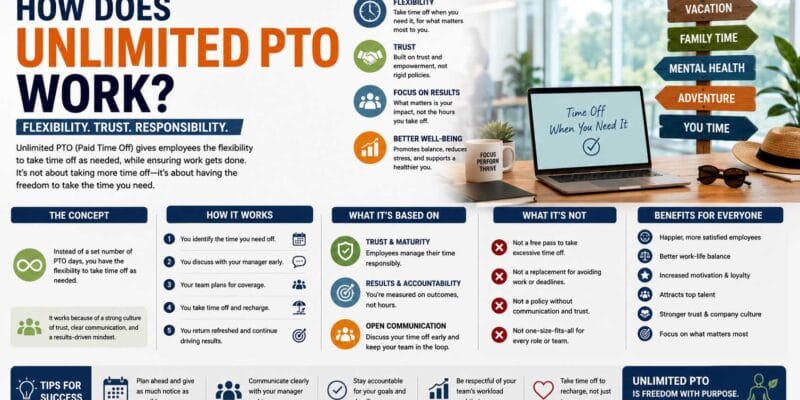
A job posting that promises “unlimited paid time off” can sound like employees can take vacations whenever they want. However, the reality is more structured. So, how does unlimited PTO work? Instead of receiving a fixed number of vacation or PTO days each year, eligible employees can generally request paid time away as needed, subject to company policies, manager approval, workload, performance expectations, and applicable employment laws.
Therefore, unlimited PTO does not usually mean unlimited vacation without restrictions. Employees still need to complete their responsibilities, coordinate absences with coworkers, and follow the employer’s leave procedures. Meanwhile, companies need clear rules so employees understand when and how they can actually use the benefit.
When managed well, unlimited PTO can offer flexibility without requiring employees to track a traditional vacation balance. Still, its value depends heavily on the workplace culture and how the policy operates in practice.
What Is Unlimited PTO and How Does It Work?
Traditional PTO usually gives employees a defined number of paid hours or days. For example, someone might receive 15 PTO days each year and see the remaining balance in an HR system.
If you first need the basic leave terminology, understanding what is pto helps explain the key difference: traditional PTO usually creates a measurable allowance, while unlimited PTO generally removes that fixed annual bank.
Under an unlimited system, eligible employees typically submit requests whenever they need time away. Then, their manager reviews the request according to company policy, staffing needs, deadlines, and other relevant factors.
If the request is approved, the employee takes the time off without deducting days from a traditional accrued PTO balance.
However, companies can set reasonable procedures and restrictions. For instance, an employer may require advance notice for vacations, limit extended absences, establish blackout periods, or require additional approval for longer breaks.
How Does Unlimited PTO Work in Practice?
The easiest way to understand unlimited PTO is through a workplace example.
Suppose David works for a company with a flexible unlimited PTO policy. In March, he wants to take three days away for a family trip. Therefore, he submits the request through the company’s HR system.
His manager checks the team’s schedule and approves it.
Later, David requests five days off during summer. Again, his manager considers staffing, project deadlines, and company policy before approving the request.
David does not start with a fixed 15-day balance that drops to seven days after these absences. Instead, each request is handled under the employer’s unlimited PTO guidelines.
That is the practical answer to how does unlimited PTO actually work: employees typically request leave when needed rather than drawing from a fixed annual vacation bank.
Still, the word “unlimited” can be misleading if employees assume approval is automatic. It usually is not.
How Employees Request Unlimited PTO
Every employer can create its own process, although many policies follow a similar pattern.
Step 1: Check the Company Policy
First, employees should read the official policy before planning a trip. The policy may explain notice periods, approval requirements, excluded leave types, maximum consecutive absences, or busy periods.
Employees researching what is unlimited pto should therefore look beyond the definition and examine how their employer actually administers the benefit.
Step 2: Consider Your Workload
Next, employees should check deadlines, scheduled meetings, customer responsibilities, and other commitments.
For example, taking a week away immediately before a major product launch may be harder to approve than choosing a quieter period.
Step 3: Submit the Request
Then, the employee submits a request through the company’s HR platform, scheduling system, email process, or another approved method.
Providing reasonable notice can make planning easier for everyone involved.
Step 4: Wait for Approval
Afterward, a manager may approve the request, discuss alternative dates, or decline it according to policy and legitimate business needs.
Employees should generally avoid making nonrefundable travel arrangements until they receive required approval.
Step 5: Prepare for the Absence
Finally, employees can complete urgent work, update coworkers, arrange coverage when needed, and communicate relevant handoffs.
As a result, the employee gets time away while the team remains prepared.
Unlimited PTO vs. Traditional PTO
Although both systems can provide paid time away, they operate differently.
| Feature | Traditional PTO | Unlimited PTO |
|---|---|---|
| Fixed annual balance | Usually | Usually no |
| PTO accrual | Often | Usually no traditional accrual |
| Balance tracking | Yes | Often not in the same way |
| Requests require approval | Commonly | Commonly |
| Workload may affect timing | Yes | Yes |
| Unused balance may exist | Yes | Usually no traditional balance |
| Employee flexibility | Depends on allowance | Potentially higher |
| Policy rules still apply | Yes | Yes |
Traditional PTO can provide clarity because employees know exactly how many hours they have available. In contrast, unlimited PTO can provide more flexibility because employees do not have to save a limited number of days for unexpected needs.
However, the actual employee experience depends on management practices. A generous-sounding unlimited policy offers little value if workers rarely feel comfortable requesting leave.
Why Do Companies Offer Unlimited PTO?
Businesses may adopt unlimited PTO for several reasons.
First, it can provide employees with greater flexibility. Instead of allocating a specific number of vacation and personal days, the employer allows eligible workers to request time according to the policy.
Second, it can reduce some administrative focus on accrued vacation balances. However, companies still need systems for recording absences, meeting legal requirements, managing schedules, and administering other types of leave.
Unlimited PTO may also support recruitment in industries where flexible benefits matter to candidates.
Still, businesses should not treat the policy as a substitute for good management. Strong employee engagement best practices include creating an environment where employees understand their benefits and feel able to use legitimate time away without unnecessary uncertainty.
Managers also need consistent guidance. Otherwise, one team could enjoy considerable flexibility while another rarely gets requests approved.
Benefits of Unlimited PTO for Employees
For example, an employee may want several shorter breaks throughout the year rather than one long vacation. Another employee might prefer a longer trip combined with only a few additional days away.
Because there is no traditional fixed balance, employees may have more freedom to request time based on their circumstances.
Another potential advantage is less anxiety about “saving” days. Under a traditional system, someone with only a few remaining PTO days may hesitate to use one for a personal need because they want to preserve time for later.
Meanwhile, unlimited PTO can make planning easier for employees who value flexible work benefits.
However, these advantages exist only when the organization has a healthy leave culture. If employees worry that taking time away will hurt promotions or performance reviews, the theoretical flexibility may not translate into real flexibility.
Possible Disadvantages of Unlimited PTO
Unlimited PTO also creates challenges.
One issue is uncertainty. Under a traditional plan, an employee can see a balance such as 120 hours and know what is available. Under an unlimited plan, the employee may wonder how much time management considers reasonable.
As a result, some employees may actually take less leave because they lack a clear benchmark.
Another potential problem is inconsistent manager approval. If the company does not establish clear guidelines, employees on different teams may receive very different experiences.
Businesses should therefore train managers and communicate expectations clearly.
Employees should also understand that unlimited PTO does not usually replace every leave category. For example, medical leave, parental leave, disability-related absences, or other legally protected leave may operate under separate policies and laws.
Do Companies Have to Pay Out Unlimited PTO?
Traditional PTO can sometimes create an accrued balance that raises questions when an employee leaves the organization.
The question do companies have to pay out pto does not have one universal answer because payout requirements can depend on the type of plan, written employer policy, employment agreements, and the law in the relevant jurisdiction.
Unlimited PTO can be different because employees generally do not accumulate a traditional bank of unused vacation hours.
Therefore, there may be no conventional unused balance available for payout when employment ends. However, employers must structure and administer their policies consistently with applicable laws.
Employees should check official company documents and local employment requirements rather than assuming the word “unlimited” automatically determines payout rights.
How Does Unlimited PTO Work for Hourly Employees?
The question how does unlimited PTO work for hourly employees can be more complicated because hourly workers are paid based on recorded working time.
Some employers may offer flexible or unlimited leave arrangements to certain hourly employees, while other programs primarily cover salaried workers. Therefore, eligibility depends heavily on company policy.
If an hourly employee is covered, the employer needs a clear method for determining how approved paid time is recorded and compensated.
For example, the policy should explain how many paid hours correspond to a full approved day away, how schedules affect payment, and which types of absences fall under the program.
Because wage-and-hour requirements vary, businesses should design these policies carefully and comply with the laws that apply to their workforce.
Employees should check their eligibility rather than assuming a company-wide unlimited PTO announcement covers every worker in exactly the same way.
Unlimited PTO Is Not the Same as a Sabbatical
A longer break from work may fall outside an ordinary unlimited PTO policy.
Understanding what is a sabbatical can help employees recognize the difference. A sabbatical is generally an extended period away from work offered under a separate employer program, often after an employee has completed a certain period of service.
For example, a company might permit ordinary vacations through unlimited PTO while handling a six-week extended break under a different policy.
Therefore, workers planning a lengthy absence should speak with HR or their manager rather than assuming an unlimited policy automatically covers it.
The same principle applies to other specialized forms of leave. Companies may maintain separate policies for parental, medical, military, bereavement, or legally protected absences.
Common Unlimited PTO Mistakes
Employees sometimes treat “unlimited” as meaning “no approval needed.” However, most programs still require employees to follow normal request procedures.
Another mistake is failing to read the policy. Employees may assume they can take several consecutive weeks away when the employer requires special approval for extended absences.
Meanwhile, managers can make the opposite mistake by discouraging nearly every request. If employees cannot realistically use the benefit, the policy can create frustration rather than flexibility.
Companies should also avoid vague expectations. Clear guidance about requesting time, handling coverage, evaluating requests, and addressing longer absences can reduce confusion.
Finally, employers should apply policies consistently and review them for compliance with applicable employment laws.
FAQs About How Unlimited PTO Works
Does unlimited PTO mean I can take as many vacation days as I want?
Not necessarily. Unlimited PTO generally removes a fixed annual allowance, but requests can still be subject to company policies, approval procedures, workload, performance expectations, and applicable law.
Is unlimited PTO actually paid?
Under an employer’s paid unlimited PTO program, eligible approved time away is generally paid according to the policy. However, employees should review the plan’s eligibility and compensation rules.
Can a manager deny unlimited PTO?
A manager may be able to deny or adjust a request based on the employer’s policy and legitimate business considerations. However, employers must also comply with applicable laws governing protected leave and employment rights.
Does unlimited PTO roll over?
Usually, there is no traditional balance to roll over because employees do not accumulate a fixed number of PTO days. Still, the exact structure depends on the employer.
Is unlimited PTO better than regular PTO?
It depends. Unlimited PTO may provide greater flexibility, while traditional PTO gives employees a defined balance. Therefore, the better option depends on the written policy, workplace culture, approval practices, and how much leave employees can realistically use.
What to Check Before Accepting Unlimited PTO
Understanding how does unlimited PTO work requires looking beyond an attractive phrase in a job description. Before judging the benefit, ask how requests are approved, whether there are recommended minimums, how longer vacations are handled, and whether employees actually feel comfortable taking time away.
Also, review which workers qualify and which types of leave remain separate. Then, compare the policy with the rest of the compensation package rather than evaluating it alone.
A strong unlimited PTO program combines flexibility with clear expectations. When employees know the rules and managers apply them consistently, the benefit can provide meaningful time away without requiring workers to manage a fixed annual vacation balance.