
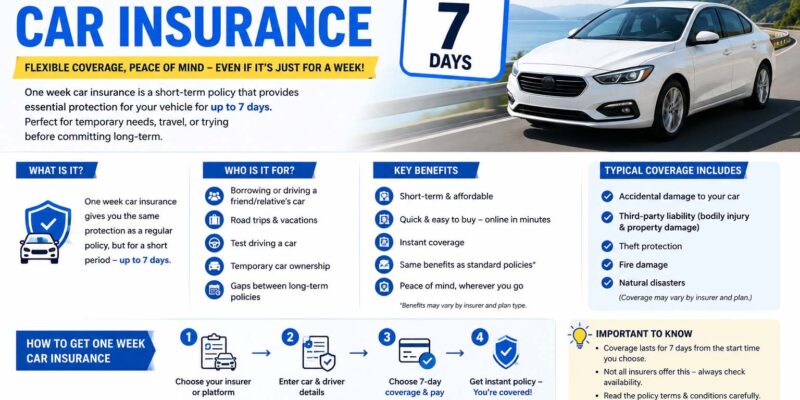
Modern drivers sometimes need flexible coverage instead of a standard long-term policy. One week car insurance generally refers to auto insurance or another coverage arrangement intended to protect a driver or vehicle for about seven days. However, availability, policy structure, and legal requirements vary by insurer and location.
Temporary coverage can be useful when borrowing a vehicle, taking a road trip, handling a short work assignment, or dealing with a temporary change in transportation. Therefore, drivers should first confirm what coverage is legally required and what options are actually available where they live.
Understanding how short-term auto coverage works can help drivers compare their options while maintaining appropriate financial protection.
What Is One Week Car Insurance?
One week car insurance describes vehicle coverage needed for roughly seven days rather than a full annual policy term. Depending on the market, an insurer may offer a short-duration policy, an endorsement, coverage under an existing policy, or another arrangement that addresses the temporary need.
However, drivers should not assume every insurer sells a stand-alone seven-day policy. Insurance products and minimum coverage requirements vary by jurisdiction.
Coverage can also differ significantly between policies. For example, one option may focus mainly on liability, while another arrangement may include protection for damage to the insured vehicle.
For drivers who are also researching how to get out of a car lease early, temporary coverage needs may arise while changing vehicles or transportation arrangements.
How Short-Term Car Insurance Works
A temporary insurance arrangement generally protects the insured driver or vehicle during the effective dates shown in the policy or related coverage documents. Therefore, drivers should confirm the exact start and end times before using the vehicle.
The National Association of Insurance Commissioners explains that auto insurance policies can provide different types of protection, while state requirements vary. Its consumer guidance also recommends comparing coverage, reviewing policy terms, and confirming that an insurer or agent is licensed. For more guidance, review the NAIC consumer information on auto insurance.
Insurers also evaluate risk when setting premiums. Factors can include:
- Driver age and experience
- Driving record
- Vehicle type
- Geographic area
- Vehicle use
- Miles driven
- Selected coverage
- Deductibles
As a result, two drivers seeking similar temporary protection may receive very different prices.
The policy documents should also show important details such as coverage limits, exclusions, deductibles, and the period when protection applies. Reading these terms before driving can prevent misunderstandings about what the policy actually covers.
Who May Need Short-Term Car Insurance?
Short-term vehicle coverage can make sense in several temporary driving situations. However, the correct solution depends on the vehicle, driver, existing policies, and local insurance rules.
Borrowing a Friend’s Vehicle
Before borrowing a friend’s car, check the vehicle owner’s existing policy. Some policies may already provide coverage for certain permissive drivers, while restrictions or exclusions may apply in other situations.
Therefore, both the owner and borrower should confirm coverage with the insurer rather than automatically buying another policy.
Road Trips
Travelers may need to review their coverage before taking a borrowed or rented vehicle on a road trip. Businesses organizing business travel planning should also confirm that employees have appropriate protection when using vehicles during short assignments.
Temporary Work Assignments
Business professionals may need vehicle coverage while working temporarily in another location. In this case, they should verify whether the vehicle use counts as personal or business use.
Buying or Changing Cars
A driver buying or changing vehicles may face a temporary coverage situation. However, the driver should arrange appropriate insurance before operating the vehicle and verify when the coverage becomes effective.
College Students Returning Home
Students who return home temporarily may want to drive a family vehicle. Instead of assuming they need a separate short-term policy, the household should first check whether the existing auto policy already covers the student.
Benefits of Temporary Car Insurance
Temporary car insurance can offer flexibility when an appropriate short-term option is available.
One potential advantage is avoiding unnecessary long-term coverage for a temporary driving need. For example, someone who needs a vehicle for only several days may prefer an arrangement that matches that limited period.
Convenience can also matter. Some insurers and insurance platforms provide online quote or application processes. However, online payment does not always mean coverage starts immediately. Therefore, drivers should confirm the effective date and time before driving.
A separate temporary arrangement may also help when adding someone to an existing policy is unnecessary or unsuitable. Still, drivers should compare both approaches before deciding.
Companies managing vehicles may also consider What Is MSRP when evaluating vehicle costs and purchasing decisions.
Business Uses for Temporary Auto Coverage
Businesses can face short-term transportation needs during projects, events, or seasonal operations. For instance, a company might rent an additional vehicle for a temporary assignment.
However, personal and commercial auto insurance are not interchangeable. Business use may require different coverage, higher liability limits, or specific commercial provisions.
Companies should therefore tell the insurer exactly how employees will use the vehicle. This information helps the insurer determine whether the proposed coverage fits the actual risk.
Businesses involved in transportation and logistics may also use the Hub and Spoke Model to organize distribution routes and operations efficiently.
How to Find One Week Car Insurance
Finding suitable short-term coverage requires more than searching for the lowest price. Instead, compare both eligibility and policy protection.
Step 1: Check Existing Coverage
First, review any current auto insurance that may already apply. If you plan to borrow a vehicle, ask the owner’s insurer whether the policy covers you.
For rental vehicles, check your existing auto policy and any applicable benefits before buying duplicate protection.
Step 2: Compare Short-Term Insurance Providers
Next, compare licensed insurers or agents that operate in your location. Look at coverage limits, exclusions, deductibles, eligibility requirements, and total price.
Step 3: Provide Accurate Vehicle Information
The insurer may need information about the vehicle, including its make, model, use, and other identifying details. Therefore, provide accurate information to avoid coverage problems later.
Step 4: Submit Driver Details
Insurers commonly consider driving experience, driving history, vehicle use, and other underwriting factors. Accurate information helps them evaluate the application correctly.
Step 5: Choose Appropriate Coverage
Then, compare the types and limits of coverage offered. Do not assume that a temporary policy automatically provides comprehensive or collision coverage.
Step 6: Review the Policy Carefully
Before paying, read the exclusions, deductibles, coverage limits, permitted uses, and effective dates. Also, check whether the policy permits business use or other special activities when relevant.
Step 7: Confirm Coverage Is Active
Finally, verify the exact effective date and time. Do not drive merely because you submitted an application or payment.
How Much Does Short-Term Car Insurance Cost?
There is no universal price for short-term auto coverage. Insurers calculate premiums according to their underwriting and rating methods, while available products differ between locations.
For example, insurers may consider the driver’s record, age, vehicle type, location, vehicle use, mileage, selected limits, and deductibles.
A high-value or high-performance vehicle may also affect the premium. Likewise, a driver with a history of claims or violations may receive a different price than a lower-risk driver.
Short-duration coverage can also cost more per day than a longer policy. However, total spending may still be lower when the driver genuinely needs protection for only a brief period.
Therefore, comparing quotes with equivalent coverage limits provides a more useful comparison than looking only at the headline price.
Common Temporary Car Insurance Mistakes to Avoid
Drivers can avoid many temporary insurance problems by checking the details before purchasing coverage.
Assuming Every Policy Provides the Same Coverage
A common mistake is assuming that every temporary policy provides broad protection. Instead, check exactly which losses and liabilities the policy covers.
Ignoring Coverage Limits
Drivers should review liability limits, deductibles, and any applicable restrictions. Otherwise, they may discover important limitations only after a loss occurs.
Not Checking Usage Rules
Some coverage may restrict certain uses of the vehicle. Therefore, tell the insurer whether you plan to use the car for personal travel, work, deliveries, ride-sharing, or another purpose.
Assuming Payment Means Immediate Coverage
Submitting payment does not always guarantee that coverage has already started. Instead, verify the effective date and time shown in your insurance documents.
Buying From an Unverified Provider
Drivers should also confirm that the insurer or agent can legally sell insurance in their jurisdiction. This check can help protect consumers from invalid or unreliable coverage.
Temporary Coverage vs. Annual Insurance
Temporary Coverage
- Designed for a limited driving need
- May offer flexible policy periods where available
- Can suit occasional or transitional situations
- Availability varies by insurer and location
- May cost more per day
Annual Insurance
- Designed for regular, ongoing driving
- Provides continuous protection during the policy term
- May offer better value for frequent drivers
- Usually provides more predictable long-term coverage
- Requires ongoing premium payments
Therefore, the better option depends on how often you drive, what vehicle you use, and which insurance products are available to you.
Technology Trends in Car Insurance
Digital technology continues to change how insurers quote, sell, and manage auto policies. For example, many companies now provide online applications, digital insurance documents, and mobile account management.
Telematics and usage-based insurance have also expanded the ways insurers can evaluate driving behavior. Depending on the program, insurers may use factors such as mileage, time of day, acceleration, braking, or other driving data.
As a result, some drivers now have options that price coverage partly according to vehicle use or driving behavior rather than relying only on traditional rating factors.
However, technology does not eliminate the need to read policy terms carefully. Drivers should still understand coverage limits, exclusions, deductibles, data practices, and effective dates.
Insurance companies also operate within broader economic conditions. Businesses studying financial risk may encounter topics such as chapter 11 bankruptcy when examining how companies restructure their financial obligations.
FAQ About Temporary Car Insurance
What is one week car insurance?
It generally means auto coverage intended to address a driving need lasting about seven days. However, insurers and jurisdictions may structure temporary coverage differently.
Is temporary car insurance legal?
Insurance laws and available products vary by jurisdiction. Therefore, drivers should buy coverage from an appropriately licensed insurer or agent and make sure the policy meets applicable requirements.
Can I get car insurance for one week instantly?
Some providers may offer fast online applications or activation. However, availability varies, and drivers should verify the effective date and time before operating the vehicle.
Is temporary car insurance expensive?
The cost depends on the driver, vehicle, location, coverage, and insurer. Although short-term protection may cost more per day, it can still make financial sense when coverage is needed only briefly.
Who may benefit from temporary coverage?
Drivers borrowing vehicles, people facing temporary transportation needs, travelers, and some business users may benefit. However, existing insurance may already cover certain situations, so checking current policies should come first.
Conclusion
One week car insurance can provide a practical solution when a driver needs appropriate vehicle coverage for only a short period and such a product is available. However, policy availability, legal requirements, coverage limits, and effective dates vary.
Before buying temporary protection, check existing insurance, compare licensed providers, review exclusions, and confirm exactly when coverage begins and ends. By focusing on the actual policy terms rather than the policy name alone, drivers can choose coverage that better matches their temporary driving needs.