
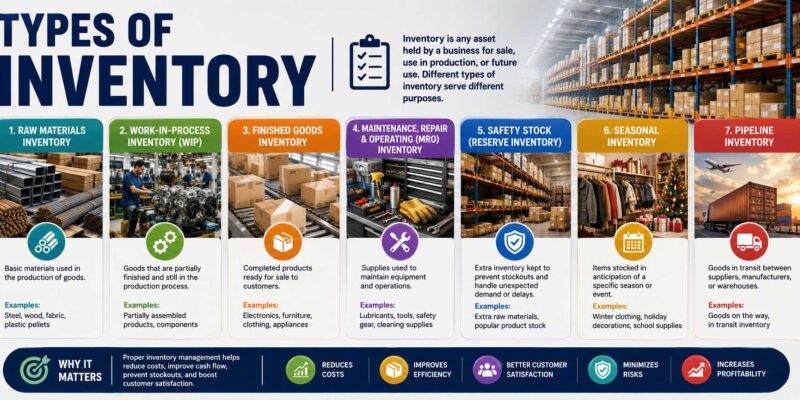
Every business that sells physical products relies on inventory. Understanding the types of inventory helps companies manage stock efficiently, reduce costs, and meet customer demand without overordering or running out of products.
Whether you own a small retail store, operate a manufacturing company, or are studying business, knowing how inventory is classified makes it easier to improve operations and make smarter purchasing decisions. This guide explains the main inventory types, how they are used, and why proper inventory management plays a key role in business success.
What Are the Types of Inventory?
The types of inventory refer to the different categories of goods a business keeps before selling a finished product to customers.
Although every industry is different, most businesses work with four primary inventory categories:
- Raw materials
- Work-in-progress (WIP)
- Finished goods
- Maintenance, repair, and operations (MRO) inventory
Each serves a different purpose within the production or sales process.
The Four Main Types of Inventory
1. Raw Materials
Raw materials consist of the basic resources required to create or manufacture products.
Examples include:
- Steel for automobile manufacturing
- Wood for furniture production
- Cotton for clothing
- Flour for bakeries
- Plastic pellets for packaging
Manufacturers purchase raw materials before production begins.
Accurately recording these purchases often starts with What Is a Purchase Order, since purchase orders help businesses track incoming inventory from suppliers.
2. Work-in-Progress (WIP) Inventory
Work-in-progress inventory consists of products that are currently being manufactured but are not yet complete.
Examples include:
- A car on the assembly line
- Half-built furniture
- Unfinished electronic devices
- Clothing waiting for final stitching
Managing WIP carefully helps reduce production delays and improves operational efficiency.
3. Finished Goods
Finished goods are products ready for sale.
Examples include:
- Smartphones on retail shelves
- Packaged food
- Completed furniture
- Finished clothing
- Consumer electronics
These products generate revenue once customers purchase them.
4. Maintenance, Repair, and Operations (MRO) Inventory
MRO inventory supports business operations rather than becoming part of the finished product.
Examples include:
- Cleaning supplies
- Safety equipment
- Lubricants
- Replacement machine parts
- Office supplies
Although customers never purchase these items directly, they help businesses operate smoothly.
Types of Inventory in Accounting
The types of inventory in accounting use the same basic categories, but their primary purpose is financial reporting rather than warehouse management.
Accountants record inventory because it represents a business asset until sold.
- Cost of goods sold (COGS)
- Gross profit
- Net income
- Taxes
- Financial statements
Businesses also maintain detailed records using What Is a Ledger, which tracks inventory-related transactions and supports accurate financial reporting.
Inventory Classification Table
| Inventory Type | Purpose | Example |
|---|---|---|
| Raw Materials | Used in manufacturing | Steel, fabric, lumber |
| Work-in-Progress | Products being built | Partially assembled furniture |
| Finished Goods | Ready for customers | Packaged electronics |
| MRO Inventory | Supports operations | Machine oil, cleaning supplies |
This classification works across many industries, from manufacturing to wholesale distribution.
Why Inventory Classification Matters
Proper inventory classification helps businesses:
- Improve purchasing decisions
- Reduce storage costs
- Prevent stock shortages
- Improve forecasting
- Increase warehouse efficiency
- Produce more accurate financial reports
Without clear categories, inventory becomes difficult to monitor and control.
Types of Inventory Management
Understanding the different types of inventory management is just as important as understanding inventory itself.
Different businesses choose different inventory strategies depending on their size, products, and customer demand.
Common inventory management approaches include:
Just-in-Time (JIT)
Businesses receive inventory only when it is required for manufacturing or customer demand.
Advantages:
- Lower storage costs
- Reduced waste
- Less capital tied up in inventory
Potential challenge:
- Higher risk of shortages if suppliers experience delays.
Just-in-Case Inventory
Companies keep extra inventory available to prepare for unexpected demand.
Advantages:
- Better protection against supply chain disruptions
- Fewer stockouts
Potential challenge:
- Higher storage expenses.
ABC Inventory Analysis
ABC analysis categorizes inventory according to value.
- A items: High value, lower quantity
- B items: Moderate value
- C items: Lower value, higher quantity
This method helps managers prioritize attention where it matters most.
Types of Inventory Management Systems
Modern businesses increasingly rely on types of inventory management systems to automate inventory tracking.
Popular systems include:
- Manual inventory systems
- Barcode systems
- RFID inventory systems
- Cloud-based inventory platforms
- Enterprise Resource Planning (ERP) systems
Automation improves inventory accuracy while reducing human error.
Types of Inventory Management Software
Choosing among different types of inventory management software depends on business needs.
Many solutions include features such as:
- Real-time inventory tracking
- Purchase order management
- Warehouse management
- Sales reporting
- Demand forecasting
- Supplier management
- Inventory alerts
Smaller businesses often prefer cloud-based software because it is affordable and easy to scale.
Real-World Example
Imagine a bicycle manufacturer.
Its inventory may include:
Raw materials
- Aluminum frames
- Tires
- Chains
- Handlebars
Work-in-progress
- Frames being welded
- Bicycles awaiting paint
Finished goods
- Fully assembled bicycles
MRO inventory
- Welding supplies
- Machine lubricants
- Safety equipment
Each category requires different planning and management.
How Lead Time Affects Inventory
Inventory planning depends heavily on supplier delivery schedules.
Understanding What Is Lead Time helps businesses determine when to reorder stock before supplies run low.
Long lead times often require companies to hold additional safety stock, while shorter lead times allow businesses to operate with leaner inventory levels.
Common Inventory Mistakes
Businesses often encounter avoidable inventory problems.
Some of the most common include:
Overstocking
Buying too much inventory increases storage costs and ties up cash.
Understocking
Running out of products leads to missed sales and dissatisfied customers.
Poor Inventory Tracking
Without accurate records, businesses struggle to forecast demand.
Ignoring Seasonal Demand
Retailers that fail to anticipate seasonal buying patterns often experience shortages or excess inventory.
Best Practices for Managing Inventory
Successful inventory management usually follows a few consistent principles.
Perform Regular Inventory Counts
Cycle counts and physical inventory audits improve accuracy.
Monitor Demand Trends
Historical sales data helps businesses forecast future purchasing needs.
Use Inventory Software
Automation reduces manual work while improving reporting.
Review Supplier Performance
Reliable suppliers improve inventory consistency.
Standardize Inventory Procedures
Documented processes reduce errors and improve employee training.
Inventory and Business Profitability
Inventory directly affects financial performance.
Too much inventory increases:
- Storage expenses
- Insurance costs
- Obsolete stock
- Cash tied up in products
Too little inventory creates:
- Lost sales
- Customer dissatisfaction
- Emergency shipping costs
Finding the right balance helps improve profitability.
Business owners should also understand the difference between revenue and profit, since high sales alone do not guarantee healthy financial performance if inventory costs remain too high.
Inventory vs. Fixed Assets
New business owners sometimes confuse inventory with long-term assets.
Inventory includes products intended for sale.
Fixed assets include equipment used to operate the business.
For example:
Inventory:
- Shoes
- Furniture
- Electronics
Fixed Assets:
- Delivery trucks
- Warehouse shelving
- Manufacturing machines
Those long-term assets lose value over time through depreciation. Learning What Is a Depreciation Schedule helps explain how businesses account for that decline while keeping inventory and fixed assets separate.
Frequently Asked Questions
What are the four main types of inventory?
The four primary categories are raw materials, work-in-progress inventory, finished goods, and maintenance, repair, and operations (MRO) inventory.
Why is inventory important?
Inventory allows businesses to meet customer demand while supporting production, sales, and financial planning.
What is inventory management?
Inventory management is the process of ordering, storing, tracking, and controlling inventory to maintain efficient operations.
Which inventory management system is best?
The right system depends on business size, industry, and budget. Small businesses often benefit from cloud-based software, while larger organizations frequently use ERP systems with advanced inventory features.
How often should inventory be counted?
Many businesses perform cycle counts throughout the year and complete a full physical inventory annually, though high-volume operations may count inventory more frequently.
Practical Takeaways for Better Inventory Management
Learning the different types of inventory gives business owners and managers a stronger foundation for making purchasing, production, and financial decisions. By separating raw materials, work-in-progress items, finished goods, and MRO supplies, companies gain better visibility into operations and reduce costly mistakes.
Pairing clear inventory classifications with reliable management systems, accurate financial records, and consistent forecasting helps businesses improve efficiency, control costs, and serve customers more effectively. Whether you’re launching a startup or managing an established company, strong inventory practices are an investment in long-term growth.