
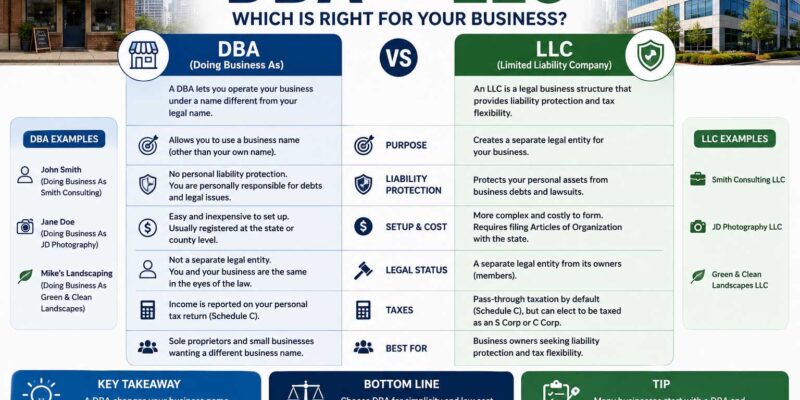
When starting a business, DBA vs LLC can sound like a choice between two competing business structures. However, they are not actually the same type of thing. An LLC is a legal business entity, while a DBA generally allows a business or individual to operate under a name different from its legal name. In fact, an LLC can have a DBA, so entrepreneurs do not always have to choose one or the other.
Understanding this distinction can prevent a common startup mistake. A DBA can help with branding, but registering one generally does not create the liability protection associated with forming an LLC. Meanwhile, an LLC involves more formal setup and ongoing state requirements.
Because business rules differ by state, entrepreneurs should always confirm current requirements with their state and local agencies before filing.
What Is a DBA?
DBA stands for “doing business as.” Depending on the state or locality, you may also hear terms such as assumed name, fictitious business name, or trade name.
Suppose Maria Lopez operates as a sole proprietor but wants to market her photography services as “Bright Frame Photography.” She may need to register that business name as a DBA, depending on local requirements.
However, registering the DBA generally does not create a separate legal entity. Maria remains the business owner operating through her existing legal structure.
This distinction becomes clearer when studying the broader types of ownership, since sole proprietorships, partnerships, corporations, and LLCs describe business structures, while a DBA primarily concerns the name under which business is conducted.
What Does a DBA Actually Do?
A DBA can allow an existing business to use another public-facing name.
For instance, a company legally registered as Hudson Ventures LLC might operate a landscaping service under “Green Street Landscaping.” Subject to applicable registration rules, Green Street Landscaping could function as the DBA while Hudson Ventures LLC remains the underlying legal entity.
Therefore, DBAs can be useful for branding or for operating multiple brands without forming a separate entity for every name.
Still, registering a DBA does not automatically give you exclusive trademark rights to that name. Trademark protection is a separate legal issue.
What Is an LLC?
Unlike a DBA, forming an LLC establishes an entity that is legally distinct from its owner or owners. One major reason entrepreneurs choose LLCs is their potential to separate business liabilities from the owners’ personal assets, although that protection has limits and depends on proper operation and the circumstances involved.
LLCs can have one owner or multiple owners. Meanwhile, management arrangements and filing requirements vary by state.
For federal income tax purposes, LLC is not itself a single tax classification. Depending on ownership and elections made, an LLC may be treated as a disregarded entity, partnership, or corporation for federal tax purposes.
Anyone confused by the tax treatment of a single-owner company may find the concept behind What Is a Disregarded Entity useful, since many single-member LLCs receive that federal tax treatment by default unless another classification is elected.
DBA vs LLC: Quick Comparison
The easiest way to understand the distinction is to compare their primary purposes.
| Feature | DBA | LLC |
|---|---|---|
| What is it? | Registered business/trade name | Legal business entity |
| Creates a separate entity? | Generally no | Yes |
| Liability protection by itself? | Generally no | Potential limited liability for owners |
| Can a sole proprietor use it? | Yes, subject to local rules | Sole proprietor can instead form an LLC |
| Can an LLC have one? | Yes | An LLC can register DBAs |
| Main purpose | Operating under another name | Creating and operating a business entity |
| Tax classification | Does not create one by itself | Depends on ownership and tax elections |
| Filing rules | Vary by jurisdiction | Governed primarily by state law |
| Ongoing requirements | Vary | State-specific filings, fees, and compliance may apply |
Therefore, the central LLC vs DBA distinction is simple: an LLC concerns the legal organization of the business, whereas a DBA concerns the name being used.
DBA vs LLC for Liability Protection
Imagine Alex operates a home repair business as a sole proprietor and registers “Alex Home Solutions” as a DBA. The DBA gives the business a marketable name, but it does not turn the sole proprietorship into a separate liability-protecting entity.
If Alex instead forms Alex Home Solutions LLC, the company becomes a separate legal entity under state law. As a result, the LLC structure may protect Alex’s personal assets from many business debts and claims.
However, LLC protection is not unlimited.
Owners may still face personal liability for their own wrongful acts, personal guarantees, or situations where limited liability does not apply. Likewise, poor separation between personal and business affairs can create legal problems.
Therefore, forming an LLC should be combined with sound business practices, proper contracts, suitable insurance, and compliance with applicable laws.
DBA vs LLC for Business Branding
For branding, a DBA can be particularly flexible.
Suppose Sunrise Retail LLC owns three different product brands. Rather than forming three separate LLCs, the company might register DBAs for each brand where permitted.
This approach can simplify branding because customers can interact with names tailored to different markets.
However, all three brands may still operate through the same underlying LLC. Therefore, a DBA does not automatically isolate the liabilities of one brand from another.
A sole proprietor can also use a DBA to create a more polished public identity. Looking at Sole Proprietorship Examples can help new entrepreneurs understand how a business owned directly by one person can operate under a separate trade name without becoming an LLC.
Still, branding should not be confused with legal protection. A professional-sounding DBA does not change the underlying entity.
LLC vs DBA Pros and Cons
The LLC vs DBA pros and cons depend on what you are trying to accomplish.
Advantages of a DBA
A DBA can provide a practical way to use a business name other than the owner’s or entity’s legal name.
Depending on the jurisdiction, advantages may include:
- easier development of a separate brand identity
- ability to operate multiple brands through one underlying business
- public use of a more memorable business name
- relatively straightforward registration in many jurisdictions
However, requirements and costs vary considerably by location.
Disadvantages of a DBA
The biggest limitation is that a DBA alone generally does not create a separate legal entity or limited liability.
Likewise, registration does not necessarily provide trademark protection. Therefore, business owners should check name availability and consider trademark issues separately when brand protection matters.
DBA registrations may also require renewals, publication, or other local procedures in some jurisdictions.
Advantages of an LLC
An LLC can offer limited liability while maintaining a flexible ownership and management structure.
It can also provide options for federal tax classification. Depending on the circumstances, an LLC may retain its default tax treatment or elect corporate taxation.
Some business owners later compare LLC taxation with the benefits of s corp taxation. However, an S corporation is a federal tax status with eligibility requirements rather than a direct replacement for the LLC legal structure, and an LLC that qualifies may elect S corporation tax treatment.
Disadvantages of an LLC
An LLC usually involves more formal obligations than simply registering a trade name.
Depending on the state, owners may face formation fees, annual or periodic reports, franchise taxes, registered-agent requirements, or other compliance obligations.
Consequently, the total cost should be checked for your state rather than estimated from a nationwide average.
Can You Have a DBA and an LLC at the Same Time?
Yes. This is one of the most misunderstood parts of the comparison.
Suppose you form:
North Coast Ventures LLC
Later, you launch a cleaning service branded as:
Fresh Home Cleaning
Instead of necessarily creating another company, North Coast Ventures LLC might register Fresh Home Cleaning as a DBA, assuming state and local rules allow it.
The legal entity would remain North Coast Ventures LLC, while customers could see the Fresh Home Cleaning brand.
This combination can make sense for companies operating multiple brand names.
However, if the businesses have significantly different liabilities, partners, investors, or financial arrangements, separate entities may sometimes make more sense. A qualified attorney or tax professional can help evaluate the specific situation.
DBA vs LLC Texas: What Changes?
People searching DBA vs LLC Texas need to distinguish between Texas entity formation and assumed-name requirements.
In Texas, LLCs are formed by filing the required formation document with the Texas Secretary of State and meeting applicable state requirements. Meanwhile, assumed-name filing requirements depend on the underlying business structure and circumstances.
A Texas LLC can also use an assumed name rather than its exact legal entity name.
However, filing rules, forms, fees, and tax requirements can change. Therefore, Texas entrepreneurs should verify current information directly with the Texas Secretary of State and Texas Comptroller before taking action.
The same principle applies elsewhere. California, Florida, New York, and other states have their own entity and assumed-name procedures.
Tax Differences Between a DBA and LLC
A DBA by itself does not create a new federal tax classification.
For example, if a sole proprietor registers a DBA, the underlying business generally remains a sole proprietorship for federal tax purposes unless its legal or tax structure changes separately.
An LLC works differently because federal tax treatment depends on its ownership and elections.
A single-member LLC is generally disregarded for federal income tax purposes by default, while a domestic LLC with two or more members is generally treated as a partnership unless it elects otherwise. Eligible LLCs can also elect corporate treatment, including S corporation status when applicable requirements are met.
Therefore, do not form an LLC or choose a tax election based solely on claims that one option always saves taxes. Tax outcomes depend heavily on business income, expenses, owner compensation, jurisdiction, and individual circumstances.
What About PLLCs?
Some licensed professionals encounter another variation: the professional limited liability company.
A PLLC is available in certain states for specified licensed professions, although rules differ considerably. Doctors, lawyers, accountants, architects, and other licensed professionals may encounter special entity requirements depending on their profession and state.
Therefore, professionals comparing PLLC vs LLC should check both state business law and the regulations of their licensing board before forming an entity.
A DBA does not substitute for these professional-entity requirements.
Pros and Cons of DBA vs LLC for a New Business
For a very small business, the decision usually starts with risk and long-term plans.
Consider a freelance designer testing a side business with limited operations. The designer might remain a sole proprietor and register a DBA if a different brand name is desired.
Meanwhile, someone opening a contracting company with employees, equipment, customer agreements, and greater liability exposure may have stronger reasons to consider an LLC or another appropriate entity.
However, risk is only one factor.
Ask yourself:
Do I need only another business name? A DBA may address that specific need.
Do I want a separate legal entity? An LLC may be more relevant.
Will I operate several brands? An LLC with one or more DBAs could be an option.
Do I have partners? Ownership agreements and entity choice become especially significant.
Does my profession have special rules? Check licensing requirements before forming anything.
What are the ongoing costs? Compare filing fees, taxes, reporting requirements, insurance, accounting, and professional services.
Common Mistakes When Choosing Between DBA and LLC
The first mistake is assuming a DBA provides limited liability protection. It generally does not.
The second is believing that forming an LLC automatically protects every business name. If the company operates under another name, an assumed-name or DBA registration may still be required depending on the jurisdiction.
Another mistake is treating LLC formation as a complete legal-protection strategy. Business owners still need to follow laws, maintain appropriate records, use contracts properly, consider insurance, and keep business and personal finances appropriately separated.
Likewise, entrepreneurs sometimes assume an LLC automatically creates the best tax arrangement. Yet tax classification is a separate issue that deserves its own analysis.
Finally, do not register a name without checking whether it creates trademark concerns. State entity-name availability and federal trademark rights are different issues.
A Simple DBA vs LLC Decision Guide
Use this sequence before filing anything:
Step 1: Identify your current structure. Determine whether you are operating as a sole proprietor, partnership, LLC, corporation, or another entity.
Step 2: Define your goal. Decide whether you primarily need a brand name, liability structure, new ownership arrangement, or tax planning.
Step 3: Evaluate business risk. Consider contracts, customers, employees, debt, property, professional services, and other potential liabilities.
Step 4: Check state and local requirements. Filing rules vary widely, particularly for assumed names.
Step 5: Compare complete costs. Include formation, renewal, reporting, taxes, insurance, and professional fees.
Step 6: Check tax consequences. Speak with a qualified tax professional when the choice could materially affect your taxes.
Step 7: Protect the brand separately when necessary. Consider trademark research if the business name has long-term commercial value.
FAQs About DBA vs LLC
Is a DBA better than an LLC?
A DBA generally provides a way to operate under another name, while an LLC creates a legal business entity.
Does a DBA protect personal assets?
A DBA by itself generally does not create limited liability protection. The protection available to an owner depends on the underlying legal structure and circumstances.
Can an LLC use a DBA?
Yes. An LLC can often register one or more DBAs or assumed names, subject to state and local requirements.
Is a DBA cheaper than an LLC?
DBA registration is often less involved than LLC formation, but costs vary by jurisdiction. An LLC may also have ongoing reports, fees, or taxes that a DBA filing alone does not create.
Does an LLC need a DBA?
Not if it operates under its exact legal name. However, a DBA or assumed-name filing may be required when the LLC conducts business under another name, depending on applicable rules.
Can I change from a DBA to an LLC?
If you operate as a sole proprietor using a DBA, you can generally form an LLC later. However, forming the LLC creates a new legal entity, so contracts, licenses, bank accounts, tax registrations, permits, and the DBA itself may need to be reviewed or updated.
Choosing the Structure That Matches Your Goal
The key to understanding DBA vs LLC is recognizing that they solve different problems. A DBA primarily helps a business operate under another name, while an LLC establishes a separate legal entity with potential limited-liability benefits.
Therefore, start by identifying what you actually need. If branding is the main goal, a DBA may be enough. If you want a separate business entity, an LLC may be more appropriate. In some cases, using an LLC together with a DBA provides both an entity structure and flexible branding.
Before filing, verify current requirements in your state and locality. For businesses with significant liability, multiple owners, complex taxes, or professional licensing requirements, getting advice from a qualified business attorney or tax professional .