
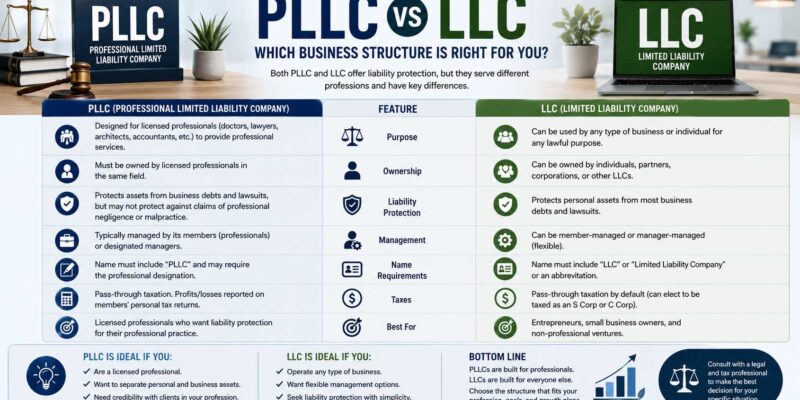
If you are a doctor, lawyer, accountant, architect, or another licensed professional starting a business, the PLLC vs LLC decision can be confusing. Both structures can provide separation between business obligations and an owner’s personal assets, but a Professional Limited Liability Company is designed specifically for certain licensed professional services in states that recognize or require it. Meanwhile, a regular LLC can serve a much broader range of businesses. The rules vary significantly by state, so your profession and location may determine which structure you can actually form.
The distinction also affects ownership eligibility, formation documents, professional licensing, and liability for professional malpractice. Therefore, choosing between the two requires more than simply comparing filing fees.
What Is an LLC?
A Limited Liability Company, or LLC, is a business entity created under state law. It combines flexible management with liability protection and offers several options for federal tax treatment.
LLCs can operate businesses ranging from consulting companies and online stores to restaurants and real estate ventures. Depending on state rules, an LLC can have one owner or multiple owners, which are called members.
Generally, members are not personally responsible for ordinary business debts solely because they own the company. However, liability protection has limits. For example, owners can still be responsible for their own wrongful acts, personal guarantees, or circumstances where legal protections do not apply.
If you are comparing LLCs with other types of ownership, looking at liability, management, taxation, startup requirements, and ownership restrictions together gives you a clearer picture than comparing entity names alone.
What Is a PLLC vs LLC?
So, what is a PLLC vs LLC in practical terms?
A Professional Limited Liability Company, usually shortened to PLLC, is a type of limited liability company intended for licensed professionals. State laws determine which professions can use it and who may own it.
Depending on the jurisdiction, eligible professions may include:
- Physicians
- Dentists
- Attorneys
- Accountants
- Architects
- Engineers
- Psychologists
- Veterinarians
- Other state-regulated professionals
A standard LLC, by contrast, usually does not require every owner to hold a professional license simply because the business is organized as an LLC.
However, professional-entity laws differ substantially between states. Some jurisdictions use professional LLCs, while others rely on professional corporations or other structures. Therefore, always check the rules for the state and licensing board that govern your profession.
PLLC vs LLC: Quick Comparison
The basic differences are easier to understand side by side.
| Feature | LLC | PLLC |
|---|---|---|
| Main purpose | General business activities | Licensed professional services |
| Owners | Individuals or permitted entities under state law | Often restricted to licensed professionals |
| Liability protection | Generally covers qualifying business obligations | Generally covers qualifying business obligations |
| Personal malpractice | Owner remains responsible for their own professional misconduct | Owner remains responsible for their own professional misconduct |
| State availability | Widely available | Not recognized in every state |
| Licensing requirements | Usually no professional license required for ordinary businesses | Professional licenses commonly required |
| Federal tax flexibility | Several classifications may be available | Generally follows LLC federal tax rules |
| Formation | State LLC filing | May require professional-specific filings or approvals |
These are broad distinctions rather than universal rules. Consequently, state law should guide the final decision.
The Biggest Difference: Professional Licensing
The defining difference in the LLC vs PLLC comparison is usually professional licensing.
Imagine two entrepreneurs starting separate businesses. One launches an e-commerce company selling household products, while the other opens an accounting practice.
The e-commerce owner may be able to organize as a regular LLC. However, the accountant may operate under professional-entity rules that require or permit a PLLC, professional corporation, or another approved structure.
Some states also restrict who can own an interest in a professional practice. For instance, ownership may need to remain entirely or primarily with professionals holding the appropriate license.
Therefore, do not assume that forming a standard LLC automatically satisfies professional licensing rules.
Does a PLLC Protect You From Malpractice Liability?
This is one of the most misunderstood parts of the PLLC structure.
A PLLC can provide liability protection for certain business obligations, but forming one does not normally eliminate a professional’s personal responsibility for their own malpractice or professional negligence.
For example, suppose two licensed professionals jointly own a professional practice. One owner personally commits professional malpractice. The PLLC structure generally should not be viewed as protection that makes the responsible professional immune from liability for their own conduct.
The treatment of another owner’s liability can depend on applicable state law and the specific facts.
Therefore, licensed professionals should consider appropriate professional liability insurance even when operating through a limited liability entity.
How LLC and PLLC Taxes Work
For federal income tax purposes, a PLLC is generally treated under the same classification framework that applies to other LLCs rather than having its own separate federal tax category.
treatment. If this concept is unfamiliar, understanding What Is a Disregarded Entity can make single-member LLC taxation much easier to follow.
Meanwhile, a multi-member LLC is generally taxed as a partnership by default for federal income tax purposes unless it elects eligible corporate treatment.
An LLC may also be able to elect taxation as a corporation. If eligibility requirements are met, an LLC can elect S corporation status as well.
However, business entity type and federal tax classification are separate concepts. An LLC does not become a corporation under state law simply because it elects corporate tax treatment.
PLLC and S Corporation Taxation
Business owners sometimes assume they must choose between a PLLC and an S corporation. In many situations, that comparison mixes a state-law entity with a federal tax election.
A qualifying PLLC may potentially elect S corporation tax status just as an eligible regular LLC can, subject to federal requirements and any relevant state rules.
Business owners researching this option often compare the benefits of s corp taxation, especially once a business produces steady earnings. Still, an S corporation election brings payroll, tax filing, compensation, and administrative considerations that should be reviewed with a qualified tax professional.
Do not choose a tax election based only on claims that it will automatically reduce taxes. Your income, expenses, compensation, ownership, state taxes, and other circumstances affect the outcome.
PLLC vs LLC Florida: A Special State-Level Question
The phrase PLLC vs LLC Florida receives plenty of searches because Florida has specific rules for professional entities.
Florida law allows certain licensed professionals to organize professional limited liability companies. However, professional services remain subject to applicable licensing requirements, and the company’s name and ownership may also need to satisfy state rules.
A professional should not assume that simply filing an ordinary LLC is enough to operate a regulated practice in Florida.
Instead, check requirements with the appropriate Florida licensing board and current state business-filing rules. This matters because requirements can vary by profession and may change.
The same principle applies outside Florida. A business structure accepted in one state may be handled differently in another.
PLLC vs Sole Proprietorship
A sole proprietorship is much simpler structurally because one individual operates a business without creating a separate state-law business entity such as an LLC.
Looking through Sole Proprietorship Examples can help new business owners understand how independently operated businesses function before comparing them with formal limited liability entities.
The major concern is liability. A sole proprietorship does not create the same legal separation between the owner and business that an LLC generally provides.
However, forming a PLLC still does not remove personal responsibility for your own professional malpractice. Therefore, professional liability should remain part of the planning process regardless of the entity chosen.
PLLC vs Partnership
When two or more professionals start a practice together, they may consider partnership arrangements as well as professional entities.
There are several types of partnerships, and their liability, management, filing, and tax characteristics differ. A general partnership, for example, can create different personal liability concerns from a properly maintained limited liability entity.
A PLLC can provide a more formal ownership and management framework. Members can establish voting rights, profit distributions, management responsibilities, procedures for adding owners, and exit arrangements through an operating agreement, subject to professional-entity laws.
For a multi-owner professional practice, these rules can become particularly valuable when disagreements or ownership changes occur.
PC vs LLC vs PLLC
The PC vs LLC vs PLLC comparison adds another option: the Professional Corporation.
A PC is a corporation organized to provide licensed professional services under applicable state law. Meanwhile, a PLLC uses the limited liability company structure, and a regular LLC generally serves broader business purposes.
Whether a professional can choose freely among these structures depends on the state and profession.
A professional corporation may have corporate governance requirements that differ from the flexible management structure commonly associated with LLCs. A PLLC, meanwhile, may offer operational flexibility while still meeting professional-entity requirements where permitted.
Tax treatment should be analyzed separately because entity structure alone does not tell you exactly how the business will be taxed.
Advantages of a PLLC
For eligible licensed professionals, a PLLC can offer several practical benefits.
First, it creates a formal legal entity for the practice. As a result, business contracts, leases, bank accounts, and qualifying obligations can be maintained through the company rather than informally through individual owners.
Second, a PLLC can offer management flexibility. An operating agreement can establish how members make decisions, distribute profits, handle ownership changes, and manage the practice.
Third, federal tax classification can be flexible, depending on the number and type of owners and any elections made.
However, those benefits need to be weighed against professional licensing restrictions and state-specific requirements.
Potential Disadvantages of a PLLC
A PLLC is not automatically the best option simply because the owners are professionals.
For one, not every state recognizes the structure. Even where PLLCs exist, formation may involve extra licensing documentation or professional-board requirements.
Ownership transfers can also be more restrictive. If only properly licensed individuals can own the practice, selling an interest to an outside investor may not be permitted.
Likewise, a PLLC does not protect a professional from liability for their own malpractice.
Finally, there may be ongoing filing fees, annual reports, registered-agent requirements, licensing costs, insurance expenses, and other administrative obligations.
How to Choose Between a PLLC and LLC
Start with your profession rather than your preferred entity name.
First, determine whether the services you provide require a state professional license. Next, check whether your state requires, permits, or restricts particular business structures for that profession.
Then consider ownership. If you have multiple members, determine whether each person must hold the same or a related professional license.
After that, compare liability rules. Ask specifically how the structure treats ordinary business debts, your own professional malpractice, and liability arising from another professional’s actions.
Next, discuss federal and state taxation with a qualified tax adviser.
Finally, consider long-term plans. Bringing in partners, hiring employees, opening additional offices, operating across state lines, or selling the practice can make ownership and licensing rules more significant.
Common PLLC Formation Mistakes
One frequent mistake is creating a standard LLC online before checking professional licensing rules. Filing acceptance does not necessarily mean the business has satisfied every licensing requirement.
Another mistake is assuming that “limited liability” means zero personal liability. Professionals remain responsible for their own misconduct in circumstances where the law imposes personal liability.
Owners also sometimes skip the operating agreement because they trust their partners. However, expectations can change as a business grows. Therefore, documenting voting, compensation, distributions, ownership transfers, departures, and dispute procedures can prevent uncertainty later.
Finally, avoid making tax elections without professional advice. A structure that works well for another practice may not fit your revenue, ownership, payroll, or state tax situation.
FAQs About PLLC vs LLC
Is a PLLC better than an LLC?
Not universally. A PLLC is designed for professional services where state law recognizes or requires that structure. A regular LLC generally works for broader business activities. Your profession and state rules may determine which is available.
Does every professional need a PLLC?
No. Requirements differ by state and profession. Some professionals use PLLCs, while others may operate through professional corporations, regular LLCs where permitted, partnerships, or other structures.
Can a PLLC have employees?
Generally, a professional practice can employ workers, but licensing rules determine who may perform regulated professional services. State-specific restrictions should be checked before assigning professional work.
Can one person own a PLLC?
In states that permit it, a PLLC may be able to have one licensed owner. However, eligibility depends on state law and professional licensing requirements.
Is a PLLC taxed differently from an LLC?
There is no separate federal PLLC tax classification simply because an entity uses the PLLC label. Federal taxation generally follows LLC classification rules, although state taxes and fees can differ.
Can a PLLC elect S corporation taxation?
An eligible PLLC may potentially elect S corporation status for federal tax purposes if it meets the applicable requirements. However, owners should review the financial and administrative consequences with a tax professional.
Making the Right Choice for Your Professional Practice
The PLLC vs LLC decision starts with one basic question: does your profession fall under special business-entity rules in your state? If it does, a PLLC or another professional entity may be required or permitted instead of a standard LLC.
From there, compare ownership restrictions, malpractice exposure, ordinary business liability, taxation, management flexibility, insurance, and long-term growth plans.
Before filing, verify current requirements with your state’s business filing authority and the licensing board responsible for your profession. For legal and tax questions specific to your practice, consulting qualified legal and tax professionals can also help you select and structure an entity that fits both current requirements and your future business plans.