
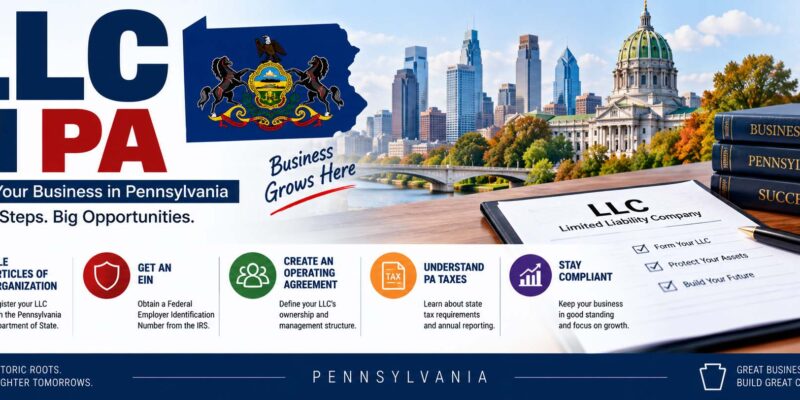
Starting a business in Pennsylvania often begins with choosing the right legal structure. If you are considering an LLC in PA, you can create one by choosing an available business name, selecting a registered office, filing a Certificate of Organization with the Pennsylvania Department of State, and completing the other steps that apply to your business. An LLC can offer liability protection while giving small-business owners a flexible way to manage and tax their companies.
You may also need an EIN, licenses or permits, tax registrations, an operating agreement, and ongoing state filings. Therefore, understanding the full process before submitting your paperwork can save time and prevent common mistakes.
What Is an LLC in PA?
A Pennsylvania limited liability company, or LLC, is a business entity formed under Pennsylvania law. Once properly created, the LLC exists as a legal entity separate from its owners, who are generally called members.
One major reason entrepreneurs choose an LLC is liability protection. In general, the company’s debts and obligations belong to the business rather than automatically becoming the personal obligations of its members. However, that protection has limits, so owners still need to operate the business properly and keep business and personal matters appropriately separated.
An LLC can have one member or multiple members. Likewise, it can work for many business models, including consulting firms, online businesses, local service companies, real estate ventures, and family-owned businesses.
If you are comparing the types of ownership available to entrepreneurs, an LLC sits between the simplicity many people associate with sole proprietorships and the more structured nature of corporations.
How to Start an LLC in PA Step by Step
If you are researching how to start an LLC in PA, focus first on the required formation process rather than buying unnecessary business services.
Pennsylvania businesses can complete much of the process through the state’s official business filing system. However, requirements can change, so always confirm current forms, fees, and instructions with the Pennsylvania Department of State before filing.
1. Choose a Name for Your Pennsylvania LLC
First, choose a legal name that complies with Pennsylvania’s naming requirements.
Your proposed name needs to be distinguishable from names already registered with the state. It also needs an appropriate LLC designation, such as “Limited Liability Company,” “Limited,” or an accepted abbreviation.
Before creating a logo, ordering signs, or buying marketing materials, check whether the business name is available.
You should also check domain names and social media usernames. Although domain availability does not determine whether Pennsylvania accepts your LLC name, matching branding can make marketing much easier later.
2. Decide on a Registered Office
Next, your LLC needs a registered office for receiving official communications and legal documents.
Pennsylvania handles this requirement somewhat differently from states that simply require every LLC to appoint a “registered agent.” A Pennsylvania LLC can generally provide a registered office address in the Commonwealth or use an authorized Commercial Registered Office Provider.
Because this information has legal significance, use accurate details and keep them updated when circumstances change.
3. File the Certificate of Organization
The central formation document for a Pennsylvania LLC is the Certificate of Organization.
You file this document with the Pennsylvania Department of State. It identifies key information about the new company and formally requests creation of the LLC.
Pennsylvania also requires formation filings to include the information required by the state’s accompanying docketing requirements.
Before submitting anything, review names, addresses, organizer details, and other information carefully. A small mistake may delay processing or require another filing later.
How to Get an LLC in PA Online
Entrepreneurs searching how to get an LLC in PA often assume they need to hire a formation company. However, business owners can file directly with the Pennsylvania Department of State.
Online filing is available through Pennsylvania’s business filing system. As a result, many entrepreneurs can handle the basic formation process themselves.
Still, self-filing is not necessarily the right choice for every company. For example, a business with several owners, outside investors, complicated tax questions, professional licensing requirements, or unusual ownership arrangements may benefit from professional legal or tax guidance.
The goal is not simply to create an entity quickly. Instead, you want a structure that makes sense for the way the business will actually operate.
Can You Register LLC in PA Online Free?
The search phrase register LLC in PA online free can be misleading.
You may find private websites advertising “free” LLC formation. However, these offers commonly exclude mandatory government filing fees or charge separately for optional services. Therefore, “free formation” does not necessarily mean creating a Pennsylvania LLC costs nothing.
Pennsylvania charges a state filing fee for the Certificate of Organization. Because government fees and procedures can change, check the current amount on the official Pennsylvania Department of State website when you are ready to file.
Also, separate costs may arise depending on your business. These could include professional assistance, permits, local registrations, insurance, accounting services, or commercial registered office services.
Therefore, calculate the complete startup cost rather than focusing only on an advertised formation price.
Create an Operating Agreement
Pennsylvania LLC owners should consider creating a written operating agreement even when the document does not need to be filed with the state as part of the standard formation filing.
An operating agreement explains how the company will operate internally.
For example, a multi-member LLC can use it to address ownership percentages, voting procedures, management responsibilities, profit distributions, member departures, and procedures for resolving disagreements.
Meanwhile, a single-member LLC can use an operating agreement to document how the company is structured and managed.
A good agreement becomes especially valuable when circumstances change. Instead of relying on verbal understandings, members have written rules to reference.
Get an EIN When Your Business Needs One
An Employer Identification Number (EIN) is a federal tax identification number issued by the IRS to identify businesses and other entities for tax purposes.
Many LLCs need an EIN, particularly when they hire employees or have multiple members. Single-member businesses may also obtain one for banking or other business purposes, depending on their circumstances.
The IRS issues EINs directly, and eligible applicants can apply without paying an IRS fee.
At this stage, owners often encounter the term What Is a Disregarded Entity when researching federal taxes. By default, a domestic single-member LLC is generally treated as a disregarded entity for federal income tax purposes unless the owner chooses to have the LLC taxed as a corporation.it elects another qualifying tax treatment.
However, entity formation and tax classification are different concepts. Forming an LLC under Pennsylvania law does not by itself tell you every federal, state, or local tax rule that will apply.
Does an LLC in PA Need a Business License?
Creating an LLC does not automatically provide every license or permit needed to operate.
That distinction matters because entrepreneurs sometimes believe that their Certificate of Organization functions as a universal business license. It does not.
The licenses you need depend on factors such as your industry, profession, location, and activities.
For example, a regulated professional may face requirements that do not apply to an online consulting business. Similarly, a restaurant may need approvals that a home-based marketing company does not.
If this distinction is unfamiliar, understanding What Is a Business License can help separate business formation from the permissions needed for specific commercial activities.
Check Pennsylvania requirements as well as applicable county and municipal rules before opening for business.
Understand Pennsylvania and Federal Tax Responsibilities
An LLC is a legal entity type, while tax classification follows separate rules.
For federal income tax purposes, the default treatment depends partly on the number of members. A single-member LLC is generally disregarded for federal income tax purposes unless it elects qualifying corporate treatment. Meanwhile, a domestic LLC with two or more members is generally treated as a partnership unless it elects qualifying corporate treatment.
Some LLC owners consider an S corporation election after discussing payroll, income, administrative costs, and tax consequences with a qualified professional.
Before making that decision, learning about the benefits of s corp taxation can provide useful background. However, an S corporation election is not automatically better for every LLC.
Pennsylvania also has its own tax and registration requirements. Therefore, owners should determine which state taxes apply to their specific activities rather than assuming the federal treatment answers every tax question.
Starting an LLC in PA: What to Do After Formation
Starting an LLC in PA does not end when the Department of State accepts the formation document.
After approval, turn your attention to running the company as a genuinely separate business.
For example, consider opening a dedicated business bank account. Keeping company funds separate from personal spending makes bookkeeping cleaner and helps maintain clear financial records.
Next, set up an accounting system. Even a small company should have a reliable way to record revenue, expenses, invoices, receipts, and tax information.
You should also obtain appropriate insurance. LLC liability protection does not replace business insurance, and the right coverage depends on your activities.
Finally, create a compliance calendar. Record tax deadlines, license renewals, state filings, insurance dates, and other recurring obligations.
Pennsylvania LLC Annual Reports
Ongoing compliance deserves attention because Pennsylvania’s LLC reporting rules have changed in recent years.
Pennsylvania now requires annual reports for many business entities, including LLCs. For LLCs, the annual report deadline is generally September 30.
That means older guides claiming Pennsylvania LLCs do not file annual reports may no longer be accurate.
A business should keep its contact information current and monitor notices from the Department of State. Likewise, owners should verify the current annual report requirements directly with Pennsylvania before each filing period.
Missing compliance obligations can create unnecessary problems, so include state reporting in your normal business administration from the beginning.
DBA vs LLC in Pennsylvania
Business owners sometimes confuse an LLC with a DBA or fictitious name.
An LLC creates a legal business entity. A fictitious name, meanwhile, generally allows a business to operate using a name other than its legal name when applicable.
For instance, imagine an LLC legally named Keystone Digital Solutions LLC. If the company wants to conduct business under another brand name, Pennsylvania’s fictitious-name rules may apply.
A deeper look at dba vs llc can help new entrepreneurs understand why registering a business name and forming a legal entity are not interchangeable actions.
Therefore, decide first what legal structure you need. After that, determine whether the business will operate under its legal name or another registered name.
Common Pennsylvania LLC Mistakes
One common mistake is paying a third-party service without first checking whether you could comfortably complete the state filing yourself. Formation services can be useful, but they are not automatically necessary.
Another mistake is choosing a company name before checking state availability. Branding work becomes expensive if you later discover that the legal name cannot be registered.
Some owners also mix personal and company finances. Instead, establish clear business financial practices early.
Likewise, do not assume forming an LLC satisfies licensing, tax, insurance, and local registration requirements. Each area needs separate attention.
Finally, avoid relying on old Pennsylvania LLC guides. Filing systems, fees, reporting rules, and forms can change, so verify current requirements with official agencies.
Frequently Asked Questions About an LLC in PA
How much does it cost to start an LLC in Pennsylvania?
Pennsylvania charges a filing fee to submit a Certificate of Organization. Other costs depend on the company and may include licenses, insurance, professional services, registered office services, or local requirements. Check the Department of State for the current filing fee before submitting your application.
Can I form a Pennsylvania LLC myself?
Yes. Many entrepreneurs file their own LLC formation documents directly with Pennsylvania. However, professional help may make sense when ownership, tax, licensing, financing, or legal arrangements are complicated.
Do I need an attorney to start an LLC in PA?
Pennsylvania does not generally require a person to hire an attorney simply to submit a standard LLC formation filing. Still, legal advice can be useful for multi-owner companies, complex operating agreements, regulated businesses, or unusual transactions.
How long does a Pennsylvania LLC take to form?
Processing times can vary based on filing method, demand, and available expedited services. Therefore, check the Pennsylvania Department of State for current processing information instead of relying on an old estimated timeline.
Does a Pennsylvania LLC need an annual report?
Pennsylvania’s current annual-report system includes LLCs, with the LLC filing deadline generally falling on September 30. Because compliance requirements can change, confirm the current instructions each year.
Turn Your Pennsylvania LLC Into an Operating Business
Forming an LLC in PA is manageable once you separate the process into clear steps: choose a compliant name, arrange a registered office, file the Certificate of Organization, handle tax identification and registrations, check licensing requirements, and create reliable internal records.
After formation, focus on the details that keep the company healthy. Separate finances, maintain accurate books, understand your tax responsibilities, obtain appropriate insurance, and track Pennsylvania’s ongoing filing requirements.
Most importantly, use Pennsylvania’s official business resources for current fees, forms, and deadlines. Formation websites can explain the process, but state and federal agencies remain the best places to confirm requirements before making business decisions.