
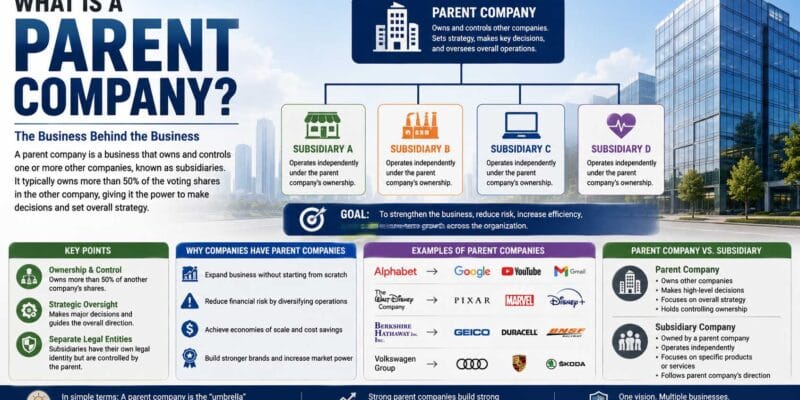
A large business can own several companies while allowing each one to keep its own name, management team, and operations. So, what is a parent company in this type of structure? A parent company is a business that owns or controls another company, known as a subsidiary. That control usually comes from owning enough voting shares to influence major decisions, although the exact structure can vary.
Parent companies are common across industries because they allow businesses to expand, acquire established brands, separate operations, and manage several business units under broader corporate control.
However, a parent company is not automatically responsible for every daily decision made by its subsidiaries. Some parents manage subsidiaries closely, while others give them considerable independence.
How Does a Parent Company Work?
A parent company generally has a controlling interest in one or more subsidiary companies.
In a straightforward example, imagine Company A purchases 80% of the voting shares of Company B. Company B can remain a separate legal entity, but Company A now has enough ownership and voting power to exercise control over it. Therefore, Company A is the parent, while Company B is its subsidiary.
Control can allow the parent to influence matters such as:
- Board appointments
- Senior leadership
- Major investments
- Business strategy
- Acquisitions and disposals
- Budgets and capital allocation
- Risk management
- Brand strategy
Still, the level of involvement varies considerably.
Some parent companies centralize finance, technology, human resources, procurement, and marketing. Others mainly oversee strategy and financial performance while subsidiary management teams handle normal operations.
Understanding types of ownership can make these structures easier to follow because ownership rights, voting power, and legal structure affect how much control one business has over another.
Parent Company vs. Subsidiary: What’s the Difference?
The distinction is mainly about control.
The parent sits above the subsidiary in the ownership structure, while the subsidiary is the company being controlled.
| Feature | Parent Company | Subsidiary |
|---|---|---|
| Position | Owns or controls another company | Is controlled by a parent |
| Legal status | Separate legal entity | Usually a separate legal entity |
| Management | May influence subsidiary leadership | May maintain its own management |
| Operations | May operate businesses directly | Often conducts its own operations |
| Strategy | Can set group-level priorities | Usually works within group strategy |
| Ownership | Holds controlling interest | Shares are controlled by parent |
A subsidiary does not necessarily lose its identity after an acquisition. For instance, it may retain its own brand, employees, offices, customers, and operating processes.
That independence is one reason large corporate groups can contain brands that consumers do not immediately realize belong to the same broader organization.
How Does a Business Become a Parent Company?
A company usually becomes a parent by creating or acquiring a controlling interest in another business.
Acquiring an Existing Company
Acquisition is one of the most common routes.
Suppose a successful food company wants to enter the organic snack market. Instead of building a new brand from scratch, it could purchase a controlling interest in an established organic snack business.
After the transaction, the acquired company may become a subsidiary.
This approach overlaps with entrepreneurship through acquisition, where business growth or ownership begins by purchasing an existing operation rather than creating every part of the business from zero.
Creating a New Subsidiary
A business can also establish a new legal entity and own it from the beginning.
For example, a company expanding internationally might create a local subsidiary in another country. Likewise, a corporation launching a substantially different business line may place the operation in a separate entity.
The appropriate structure depends on legal, tax, financing, operational, and risk considerations.
Increasing an Existing Ownership Stake
A business may initially own a minority interest in another company and later purchase enough shares to gain control.
However, determining control can involve more than simply looking at a percentage. Voting rights, shareholder agreements, board representation, and applicable accounting and corporate rules can also matter.
What Is a Common Parent Company?
The phrase what is a common parent company usually comes up when two or more businesses are controlled by the same parent.
Imagine Company P owns Company A and Company B. Company P is the common parent of both businesses.
Company A and Company B are therefore related through their shared ownership, even though neither necessarily owns the other.
This arrangement is common in corporate groups containing multiple brands or business units.
For example, one subsidiary might manufacture products while another handles distribution. Meanwhile, another subsidiary could operate in a different geographic market.
A common parent can coordinate strategy across these businesses while keeping their legal entities separate.
Parent Company vs. Holding Company
People sometimes use “parent company” and “holding company” as though they mean exactly the same thing. However, there can be a practical distinction.
A parent company may own subsidiaries while also conducting its own active business operations. For instance, it could sell products directly while controlling several other companies.
A pure holding company, by contrast, is generally structured primarily to own interests in other businesses or assets rather than conduct substantial operating activities itself.
Therefore, a holding company can be a parent company, but not every parent company functions purely as a holding company.
The precise legal and tax treatment depends on the jurisdiction and structure involved. Consequently, businesses considering either arrangement should obtain professional legal, accounting, and tax guidance.
For U.S. public companies, the U.S. Securities and Exchange Commission’s company filings database can help investors research corporate filings and understand disclosed relationships within corporate groups.
Why Do Businesses Use Parent-Subsidiary Structures?
Businesses have several reasons for creating corporate groups instead of putting every activity inside one entity.
Expansion Into New Markets
A parent can acquire an established company to gain access to customers, employees, intellectual property, distribution networks, or geographic markets.
As a result, an acquisition may accelerate expansion compared with building the same capabilities internally.
Keeping Established Brands
Acquiring a successful company does not always mean replacing its name.
If customers already trust the subsidiary’s brand, maintaining that identity may make more commercial sense.
Separating Business Operations
Companies may place distinct operations into separate subsidiaries.
For example, a group might operate one company for manufacturing and another for retail activities.
Separate entities can help organize management, accounting, financing, contracts, and ownership. However, legal separation does not automatically eliminate every possible liability or financial connection between entities.
Centralizing Shared Resources
A parent company may provide services across its subsidiaries, including accounting, technology, legal support, procurement, or human resources.
As a result, the group may reduce duplicated functions while allowing individual businesses to maintain operational specialization.
Parent Companies and Business Entity Choices
Creating subsidiaries requires decisions about the legal form of each entity.
Depending on the jurisdiction and business needs, an organization may consider corporations, limited liability companies, partnerships, or other available structures.
For U.S. businesses, understanding the benefits of s corp may be useful when evaluating certain tax elections. However, S corporation eligibility and ownership restrictions mean this structure will not suit every parent-subsidiary arrangement.
Likewise, entity classification for tax purposes does not always match how a business appears organizationally. Anyone researching What Is a Disregarded Entity will find that some entities can remain legally separate while receiving different treatment for certain federal income tax purposes.
Because tax and legal consequences can become complicated quickly, business owners should not create subsidiaries solely because the structure appears convenient on an organizational chart.
Advantages of a Parent Company Structure
One major benefit is strategic flexibility.
A parent can own businesses serving different customers or markets without combining all operations into a single brand.
Another potential benefit is specialization. Each subsidiary can develop its own management expertise, workforce, products, and operating strategy.
Acquisitions can also become easier to integrate when the purchased company remains a distinct subsidiary. Instead of immediately combining every system and department, the parent can decide which functions should stay independent.
Corporate groups may also sell individual subsidiaries when strategy changes. In some circumstances, disposing of one separately organized business can be more straightforward than extracting a deeply integrated division from a single company.
However, these advantages depend on how the group is structured and managed.
Risks and Disadvantages to Consider
More entities usually mean more administration.
Each subsidiary may require separate governance, accounting records, contracts, regulatory filings, licenses, tax compliance, and other documentation depending on local requirements.
Management can also become complicated.
If the parent exercises too much control over routine decisions, subsidiary managers may have little freedom to respond quickly to their markets. Yet if oversight is too weak, subsidiaries may move in directions that conflict with the group’s strategy or risk standards.
Corporate groups can also become difficult for employees, investors, suppliers, and customers to understand when responsibilities are unclear.
Meanwhile, acquisitions themselves carry risks. Paying too much for a subsidiary, failing to integrate essential systems, losing key employees, or misunderstanding the acquired company’s market can reduce the expected value of the transaction.
What Is the Opposite of a Parent Company?
If someone asks what is the opposite of a parent company, the closest term in a corporate ownership relationship is usually subsidiary.
A parent controls another company, while a subsidiary is controlled by the parent.
However, corporate structures can contain several layers.
For example:
Parent Company
↓
Subsidiary A
↓
Subsidiary B
In this case, the top-level parent controls Subsidiary A, while Subsidiary A also controls Subsidiary B.
You may also encounter terms such as affiliate, associate, sister company, or division. These terms do not necessarily mean the same thing as subsidiary, so you should always check the specific ownership relationship.
A sole proprietorship provides a very different comparison because the business and owner do not have the same type of corporate parent-subsidiary relationship. Looking at Sole Proprietorship Examples can therefore help beginners see how a simple owner-operated structure differs from a multi-entity corporate group.
Parent Company Examples in Practice
Consider a fictional company called Northstar Consumer Group.
Northstar owns three businesses:
- BrightHome Appliances sells household appliances.
- FreshCup Coffee operates coffee shops.
- Northstar Logistics provides transportation and warehousing services.
Northstar Consumer Group controls all three, making it their parent company.
However, each subsidiary can maintain separate employees, management, customers, contracts, and financial records.
Northstar might set group-wide financial targets and approve major investments while allowing each subsidiary’s leadership team to make routine operational decisions.
This example demonstrates why a parent company does not need to operate every subsidiary as though it were one department.
Common Mistakes When Understanding Parent Companies
A frequent mistake is assuming that a parent and subsidiary are legally the same company.
They are often separate legal entities, although their exact responsibilities and relationships depend on the structure and applicable law.
Another mistake is assuming a parent must own 100% of a subsidiary. Full ownership is possible, but control can exist without owning every share.
People also sometimes assume that every corporate division is a subsidiary. A division can simply be an internal part of the same legal entity, whereas a subsidiary generally exists as a separate legal entity.
Finally, do not assume the parent always manages every employee or operational decision. Corporate control and day-to-day management are related but different concepts.
What Is a Parent Company? FAQs
What Does a Parent Company Mean in Simple Terms?
The simplest answer is that it is a company that owns or controls another company. The controlled business is called a subsidiary.
Does a Parent Company Own 100% of a Subsidiary?
Not necessarily. A parent can own all of a subsidiary, but it can also exercise control while other shareholders retain an ownership interest.
Can a Subsidiary Have Its Own Brand?
Yes. Many subsidiaries retain separate brands, websites, employees, management teams, and customer relationships.
Can a Company Have More Than One Subsidiary?
Yes. A parent company can control multiple subsidiaries, sometimes across different industries or countries.
Is a Subsidiary the Same as a Branch?
No. A subsidiary is generally a separate legal entity. A branch is typically an extension of the same legal entity, although terminology and legal treatment vary by jurisdiction.
Can a Subsidiary Own Another Subsidiary?
Yes. Multi-level corporate structures are possible, so one subsidiary may own or control another entity below it.
Is a Parent Company Always a Large Corporation?
No. The concept depends on ownership and control, not simply company size. A smaller business can become a parent if it establishes or acquires a controlling interest in another company.
Key Points for Understanding Parent Companies
Knowing what is a parent company becomes much easier once you separate ownership from everyday operations. The parent controls another business through an ownership or governance relationship, while the subsidiary usually remains its own legal entity.
For entrepreneurs, the structure can support acquisitions, new markets, separate brands, and specialized operations. At the same time, multiple entities can increase administrative, tax, legal, and management complexity.
Therefore, anyone considering a parent-subsidiary structure should first identify the business reason for creating it. Then, legal and tax professionals can help determine whether the proposed ownership arrangement fits the company’s goals and the rules that apply in its jurisdiction.